Breast Reduction Surgery: Treatment for Hypertrophy
Breast reduction surgery is a surgical procedure that lifts and reduces the volume of hypertrophic breasts by removing excess skin and mammary gland. The position of the areola and nipple is refocused during the procedure. Breast reduction surgery is only covered by the French Assurance Maladie when more than 300 grams per breast are removed. Otherwise, it is considered cosmetic surgery, and is not covered by social security. As Dr Christelle Santini is not covered by a convention, an additional fee will be charged.

What are the indications for breast reduction surgery?
While many women wish to increase the volume of their breasts, others may suffer from overly large breasts. This breast hypertrophy can have both genetic causes (breast hypertrophy sometimes visible as early as adolescence) and acquired causes such as weight gain or various hormonal surges such as pregnancy or breastfeeding, or on the contrary, during the menopause.
Breast hypertrophy or overly large breasts can have multiple consequences on the body, which may justify breast reduction surgery:
- aesthetic repercussions, as overly large breasts can upset the balance and lightness of the figure and bust.
- psychological repercussions, with discomfort when undressing, in private or social life, or when dressing.
- medical repercussions, as overly large breasts alter the center of gravity, and encourage spinal pain in the neck, back and shoulders.
In some cases, these medical causes may justify partial reimbursement of breast reduction surgery by the health insurance scheme. After a clinical and aesthetic examination, Dr Christelle Santini will be able to tell you whether or not your surgery is eligible for reimbursement. To be eligible for reimbursement by the French health insurance system, excess breast tissue removed must weigh at least 300 g per breast. As Dr Christelle Santini's practice is not covered by a convention, you should expect to pay a higher fee.
What should I do before undergoing breast reduction surgery?
Two surgical consultations are recommended before any cosmetic or plastic surgery procedure. Dr. Christelle Santini performs a clinical examination, to suggest the best surgical response for your morphology.
Pre-operative mammography and ultrasound are systematically performed prior to breast plastic surgery.
An anesthesia consultation is mandatory prior to breast reduction surgery. You must bring the results of the blood test prescribed during the consultation.
Medical photographs are always taken prior to surgery to facilitate the surgical procedure and postoperative follow-up.
A non-wired medical support bra, made of elastic fabric and opening from the front, is prescribed for the post-operative period and must be worn for 6 weeks, day and night.
Dr. Christelle Santini also always gives you the most important medical instructions, including :
- Smoking cessation 1 month before surgery.
- Stop taking aspirin, anti-inflammatory drugs or oral anticoagulants for 15 days prior to surgery.
- Oral contraception stopped 1 month before.
What is the procedure for a breast reduction?
Reduction mammoplasty, whether unilateral or bilateral, always takes place under general anaesthetic, and lasts between 1.5 and 3 hours. The patient is admitted to hospital the day before or the morning of the operation, and returns home the day after the reduction mammoplasty.
You must fast on the morning of the operation from midnight the night before (no drinking, eating or smoking) and wear a medical bra on the day of the breast reduction procedure.
Dr Christelle Santini chooses the approach according to the patient's morphology and expectations, within the limits of technical possibilities. She will also determine the type of scar to be produced during the operation, with three possibilities:
- A circular mammoplasty scar around the areola, constant ;
- A vertical breast surgery scar located between the lower pole of the areola and the submammary fold is common;
- A horizontal scar in the submammary fold (sea anchor scar). This horizontal incision is not made if breast morphology and skin elasticity allow. The length of the scar depends on breast morphology: the more voluminous the breast and the wider its base, the longer the scar. The scar will also be longer if there is a lot of fat in the axillary extension.
In cases where scars are a source of discomfort, Dr Santini offers UrgoTouch laser sessions to significantly reduce their appearance.
In the second stage, Dr Christelle Santini removes the excess breast volume, with two main requirements:
- ensure perfect hemostasis to minimize postoperative pain and the risk of hematoma;
- achieve sufficient glandular resection to ensure a natural, harmonious and symmetrical result, with a well-positioned nipple.
The excess skin is then resected, as in the case of breast ptosis.
Finally, the incisions are closed, usually with absorbable thread, and a drain is placed for 24 hours. The drain is used to evacuate any effusion and blood that may stagnate in the surgical site, and helps to limit pain, speed recovery and reduce the risk of complications. It is checked the following day, and removed if production is low.
What to do after a breast reduction?
After the procedure, monitoring takes place first in the recovery room, then in your room. The suction drainage system is usually kept for 1 to 2 days, depending on production. The dressing is redone the day after the operation, and will need to be changed every day for 10 days.
A light dressing will be applied, and you will need to wear the non-wired compression bra prescribed prior to surgery. This bra must be worn day and night for 6 weeks to two months.
Hospitalization lasts between 1 and 2 days maximum. It is recommended that someone accompany you home.
You may shower for the first time the day after the operation, and every day thereafter, as you renew your dressings.
Swelling disappears after 2 to 6 weeks, but the final result in terms of breast volume and shape is not seen for 6 months.
We need to wait at least 12 to 18 months to judge the final appearance of the scars.
Sports activities must be stopped for about 2 months.
Vertical scar-only breastplasties often look very ugly for the first few weeks. This is nothing to worry about, however, as the breast takes on its natural shape in about two months.
Several follow-up consultations are carried out: one within seven days of the operation, then at 6 weeks, 3 months, 6 months and 1 year after the operation to monitor the evolution of the shape and scars.
Breast reduction surgery can lead to a reduction in areola sensitivity, which can be permanent, although this is rare.
It's important to know that any cosmetic surgery procedure can also carry the risk of complications. Don't hesitate to discuss this with Dr. Santini during your consultation: she will be able to explain the benefits and risks associated with this procedure in general, and in your case in particular, depending on your medical history.
Breast monitoring by mammography as part of routine breast cancer screening is little or not affected by breast reduction surgery. However, it is advisable to perform a baseline mammogram a few months after the operation.
However, it is essential to protect breast scars from the sun for 6 to 12 months.
Pregnancy should also be avoided for 1 year after the operation, to avoid damaging the aesthetic result of reduction mammoplasty. Breast-feeding is sometimes possible after the operation, but cannot be guaranteed.
If breast reduction is not covered by social security, you should expect to be off work for around 10 days after the operation, as no sick leave will be prescribed. On the other hand, in the case of significant breast hypertrophy, sick leave and other expenses are covered by the health insurance fund.
Highlights of breast reduction
- Breast volume reduction and correction of breast ptosis (sagging breasts)
- Procedure covered by social security under certain conditions (removal of 300 g per breast operated on or more)
- High patient satisfaction with aesthetic and functional improvements (back pain)
Breast reduction: what are the results?
Breast reduction relieves physical discomforts such as back and shoulder pain, while balancing the figure. Results are visible immediately after the operation, but post-operative swelling gradually diminishes, with final results visible in 6 months.
The results of this procedure are long-lasting, but can be influenced by factors such as weight gain or pregnancy.
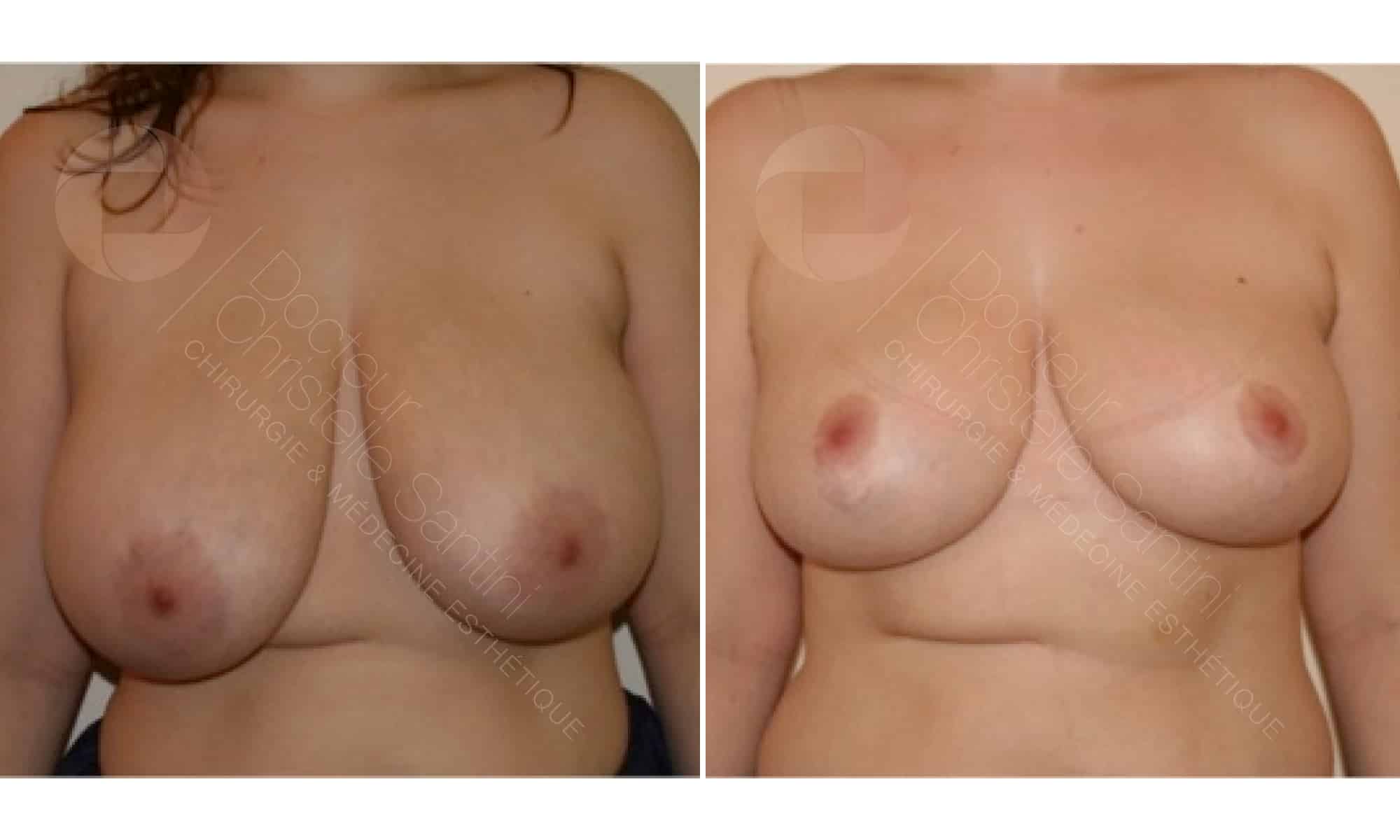
Breast reduction
Bilateral breast reduction of 380 g right breast and 375 g left breast 6-month result in a 23-year-old patient
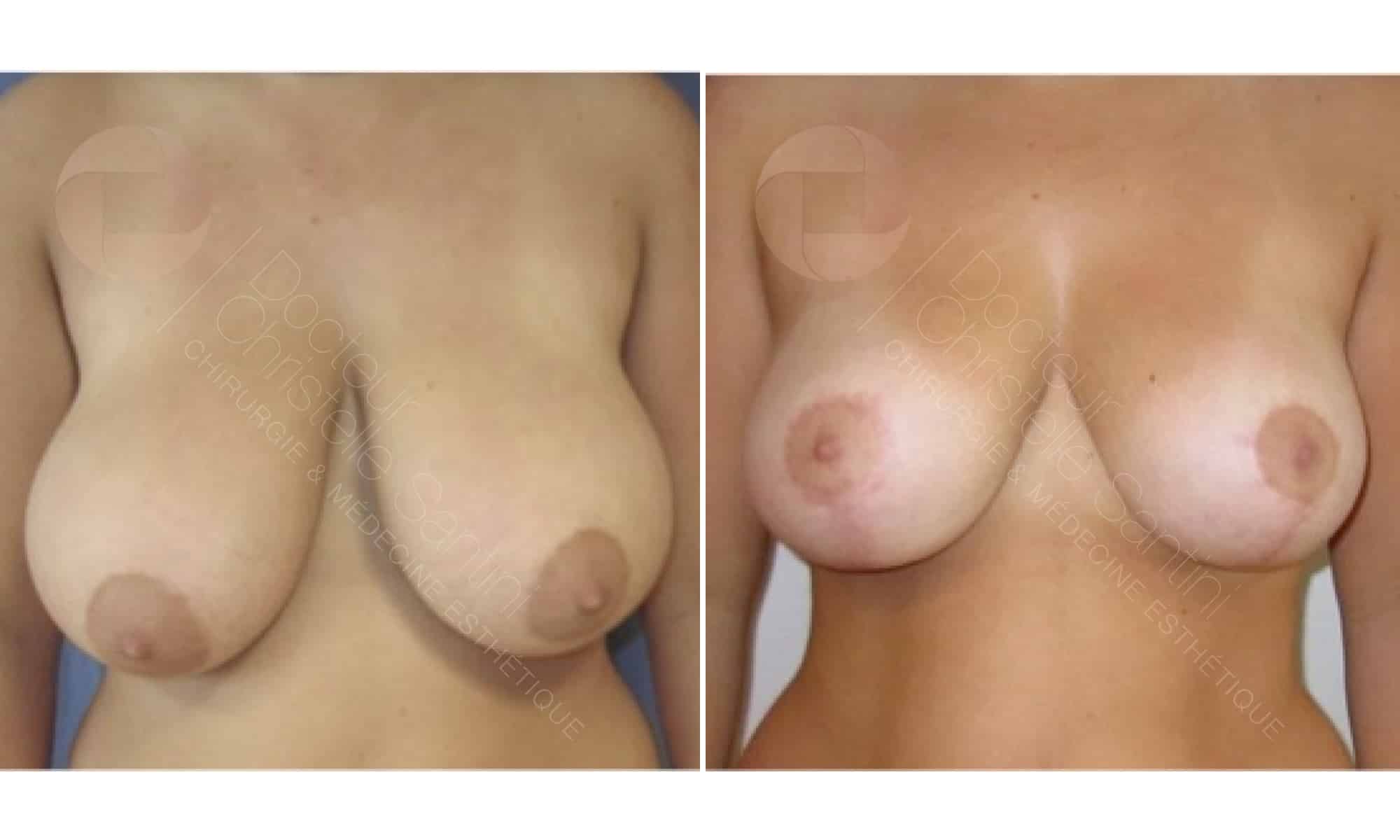
Breast reduction
Bilateral breast reduction of 300g right breast and 318g left breast at 6 months in a 19-year-old patient
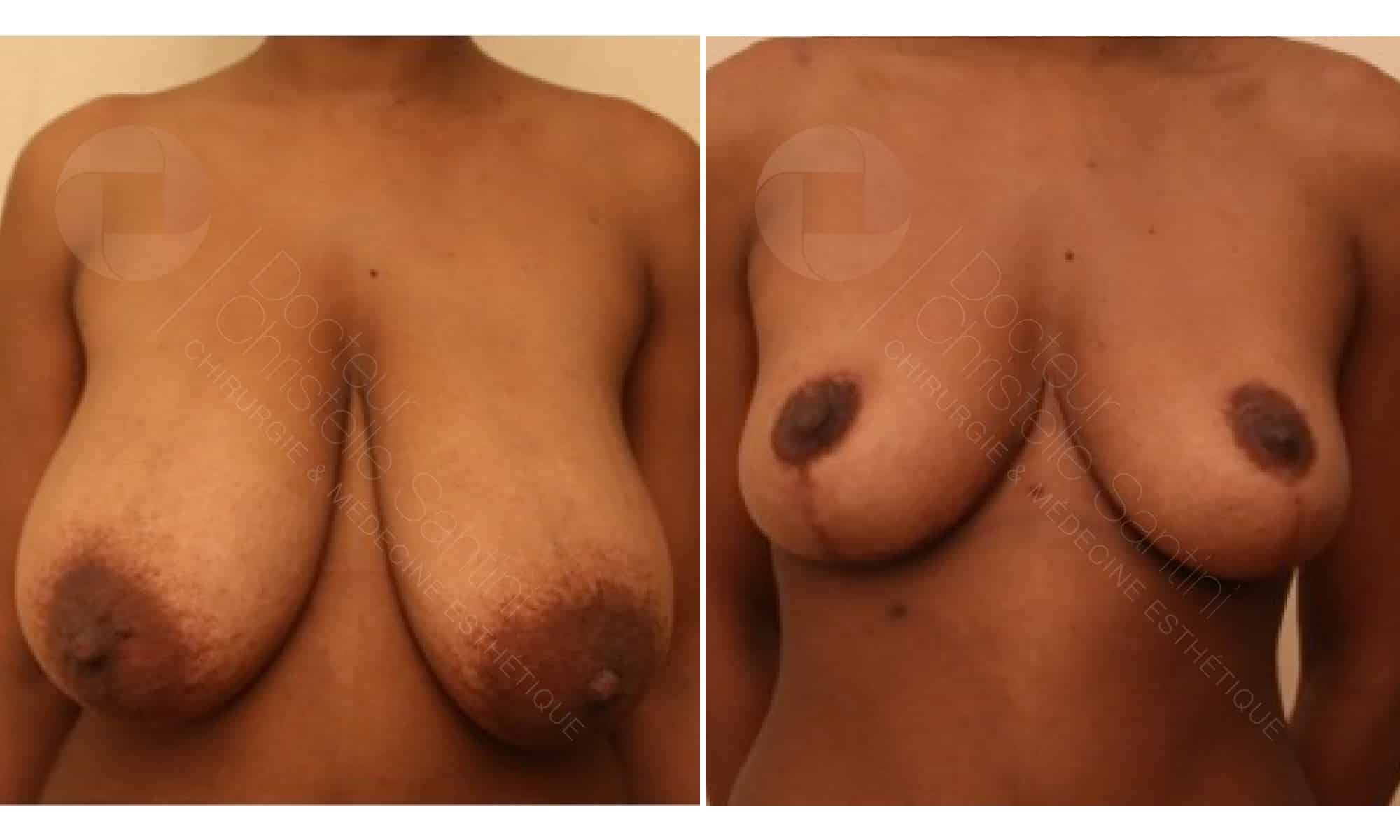
Breast reduction
36-year-old female patient undergoing bilateral breast reduction by Dr Santini, Paris plastic surgeon
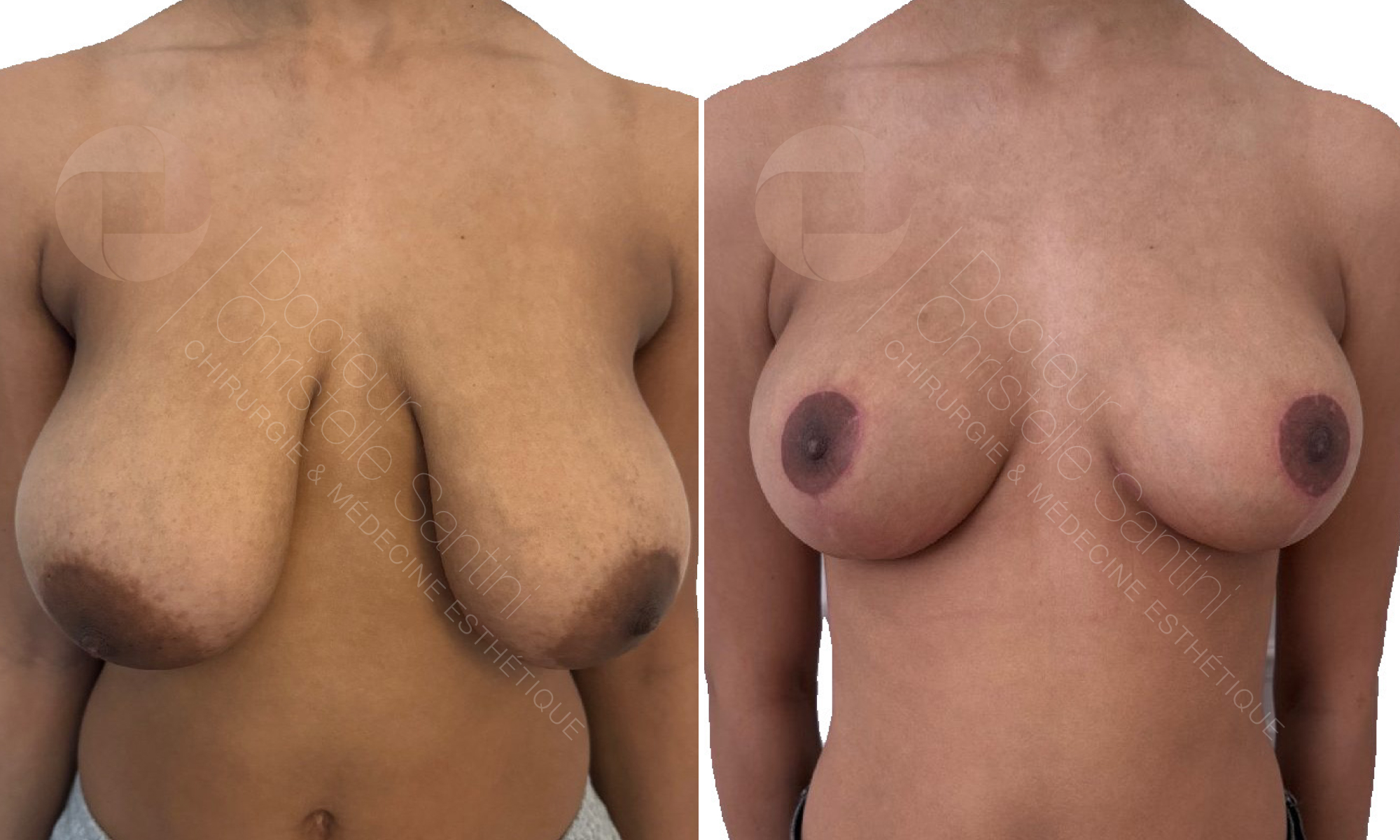
Breast reduction
Bilateral breast reduction by Dr Santini, Paris plastic surgeon
Breast reduction in brief...
What to do before a breast reduction?
- 1 to 2 plastic surgery consultations with a quote and medical photographs.
- A mandatory 15-day cooling-off period, unless covered by social security.
- Consultation with anaesthetist, blood test, mammogram +/- breast ultrasound as appropriate
How is a breast reduction performed?
- Breast reduction under general anaesthetic
- 2 to 2.5 hours for bilateral breast reduction
- Anatomopathological analysis of the removed gland
- Return home the day after breast reduction.
- A medical support bra is fitted at the end of the operation, to be worn for 2 months.
What is the post-operative course of a breast reduction?
- The sutures used are absorbable.
- Follow-up consultation with Dr Santini 7 to 10 days after breast reduction
- No sport for 6 to 8 weeks after breast reduction
- Allow 10 to 15 days of professional downtime
- Final result of breast reduction after 12 months
- Medical follow-up for one to two years after breast reduction

WRITTEN AND MEDICALLY REVIEWED BY:
Dr Christelle Santini
specialist in cosmetic surgery & medicine in paris

I am Dr. Christelle Santini, a specialist in cosmetic surgery and medicine with over 16 years of experience, based in Paris. I am:
- Surgeon qualified by the Collège Français de Chirurgie Plastique et Esthétique, registered with the Conseil de l'Ordre des Médecins in Paris.
- Member of the French Society of Plastic, Reconstructive, and Aesthetic Surgery (SoFCPRE).
- Former Assistant Chief of Staff at the Paris School of Medicine.
- My RPPS ID: 10005192595
My goal is to provide each patient with personalized care that combines transparency and safety with technical expertise and natural-looking results.
Our exchanges with Internet users
Youna
Publié le 14 août 2026
Bonsoir Dr, je songe réduire le volume de ma poitrine qui me cause d’importantes douleurs de dos au quotidien. À partir de quel volume retiré une prise en charge par la Sécurité sociale est-elle envisageable ? Je vous remercie pour votre attention.
Dr Santini
Publié le 01 septembre 2026
Bonsoir,
Merci pour votre question.
Une réduction mammaire peut bénéficier d’une prise en charge par la Sécurité sociale lorsqu’il est prévu de retirer au moins 300 grammes de glande mammaire par sein. Cette intervention peut notamment être indiquée en cas d’hypertrophie mammaire responsable de douleurs dorsales, cervicales ou d’une gêne importante au quotidien.
Lors de la consultation, j’évaluerai votre poitrine et votre morphologie afin de déterminer si vous répondez aux critères de prise en charge et de vous proposer une réduction mammaire adaptée à votre situation.
Bien cordialement.
Callie
Publié le 24 juin 2026
Je souffre au quotidien d’une hypertrophie mammaire importante qui me cause de vives douleurs dorsales. J’envisage une chirurgie de réduction pour retrouver du confort. À partir de quel volume de glande retiré par sein l’intervention est-elle éligible à une prise en charge par la Sécurité sociale ? Faut-il faire une demande d’entente préalable en amont de la consultation? Merci pour vos éclaircissements.
Dr Santini
Publié le 07 juillet 2026
Bonjour,
Une réduction mammaire peut effectivement être prise en charge par la Sécurité sociale lorsqu’elle répond à certains critères médicaux. En règle générale, cette prise en charge est possible si l’intervention prévoit le retrait d’au moins 300 grammes de glande mammaire par sein. Cette indication est évaluée lors de la consultation, après un examen clinique.
Il n’est pas nécessaire d’effectuer une demande d’entente préalable avant la consultation. Si les critères sont remplis, je vous expliquerai les démarches administratives à suivre et vous remettrai les documents nécessaires.
Une consultation permettra également d’évaluer l’importance de votre hypertrophie mammaire, l’origine de vos douleurs dorsales et de vous proposer la technique de réduction mammaire la plus adaptée à votre morphologie.
Bien cordialement,
Victoire
Publié le 18 avril 2026
Ma poitrine trop lourde me cause des douleurs aux cervicales insupportables et je n’en peux plus d’être limitée dans mes mouvements. J’aimerais savoir si dans mon cas une prise en charge ou un remboursement de la sécurité sociale est envisageable, et quelles sont les démarches à suivre pour monter le dossier ? Bien à vous.
Dr Santini
Publié le 22 avril 2026
Bonjour,
Les symptômes que vous décrivez (douleurs cervicales, gêne au quotidien, limitation des mouvements) peuvent en effet correspondre à une hypertrophie mammaire pouvant relever d’une prise en charge.
En France, une réduction mammaire peut être remboursée par la Sécurité sociale lorsqu’il existe une indication médicale, notamment avec des douleurs ou une gêne fonctionnelle, et à condition qu’un volume suffisant soit retiré lors de l’intervention (en pratique, environ 300 g par sein).
La démarche est simple :
• une consultation permet d’évaluer votre situation clinique
• si les critères sont remplis, l’intervention est considérée comme réparatrice
• un devis et les éléments médicaux vous seront remis pour votre dossier
Il est important de noter que même en cas de prise en charge, certains frais (notamment les dépassements d’honoraires) peuvent rester à votre charge, selon votre mutuelle.
Une consultation permettra de faire le point précisément sur votre situation et de vous orienter au mieux.
Bien cordialement
Klervi
Publié le 27 mars 2026
Porter une poitrine trop lourde est un calvaire quotidien, entre les douleurs de dos incessantes et la difficulté pour s’habiller ou faire du sport. Cette réduction a été le meilleur cadeau que j’ai pu me faire. Je me sens beaucoup plus légère, ma silhouette est équilibrée et je n’ai plus ces marques d’élastiques douloureuses sur les épaules.
Dr Santini
Publié le 01 avril 2026
Bonjour,
La réduction mammaire est une intervention particulièrement bénéfique en cas d’hypertrophie mammaire, permettant de soulager les douleurs de dos, d’améliorer le confort au quotidien et de retrouver une silhouette plus harmonieuse.
Je suis ravie que cette chirurgie des seins vous ait apporté un réel mieux-être, tant sur le plan physique que dans votre qualité de vie.
Bien à vous.
Arzu
Publié le 09 janvier 2026
Bonjour Dr, souffrant d’une hypertrophie mammaire qui me cause des douleurs au dos, je souhaite faire une réduction mammaire. Quelles sont les conditions pour obtenir un remboursement de la sécurité sociale ? Est-ce que vous vous occupez des démarches d’entente préalable ?
Dr Santini
Publié le 13 janvier 2026
Bonjour,
La prise en charge par la Sécurité sociale pour une réduction mammaire est étudiée au cas par cas, selon des critères médicaux précis. Elle dépend notamment de l’importance de l’hypertrophie mammaire et du volume de tissu retiré, ainsi que des symptômes associés (douleurs dorsales, cervicales, gêne fonctionnelle, etc.).
Lors de la consultation, un examen permet d’évaluer votre situation et de déterminer si une demande d’entente préalable peut être justifiée. Cette demande est ensuite transmise à la Sécurité sociale, qui reste seule décisionnaire concernant un éventuel remboursement.
Je précise par ailleurs que je ne suis pas conventionnée, ce qui signifie que mes honoraires ne sont pas soumis aux tarifs de la Sécurité sociale. En cas d’accord de prise en charge, celle-ci ne concerne qu’une partie des frais, selon les bases de remboursement en vigueur.
Je reste bien entendu à votre disposition en consultation pour en discuter plus en détail et répondre à vos questions de manière personnalisée.
Jody
Publié le 25 novembre 2025
J’ai subi une réduction mammaire il y a quatre mois, et je suis très satisfaite du volume qui a été atteint. Cependant, j’observe que mes seins ont une forme très ronde et très haute
Dr Santini
Publié le 26 novembre 2025
Bonjour,
À quatre mois d’une réduction mammaire, la forme des seins n’est pas encore définitive. Il est très fréquent qu’ils apparaissent plus ronds ou légèrement plus hauts dans les premiers mois : les tissus sont encore en phase d’assouplissement, et la peau poursuit son processus de réadaptation.
Au fil du temps, les seins prennent généralement une forme plus naturelle et plus souple, en s’installant progressivement. Le résultat continue d’évoluer jusqu’à 6 à 12 mois après l’intervention.
Si vous avez le moindre doute ou souhaitez que je vérifie l’évolution, n’hésitez pas à revenir en consultation. Cela me permettra de vous rassurer et de suivre votre cicatrisation de façon personnalisée.
Dorine
Publié le 13 octobre 2025
Souffrant d’un inconfort physique lié à la taille de ma poitrine, qui impacte ma posture, mon sommeil et ma qualité de vie au quotidien, j’envisage désormais une réduction mammaire. Je souhaiterais savoir dans quelles conditions cette intervention peut être prise en charge par la sécurité sociale ou ma mutuelle. Merci par avance pour vos retours ou conseils
Dr Santini
Publié le 30 octobre 2025
Bonjour,
La réduction mammaire peut en effet être envisagée lorsque la poitrine occasionne un inconfort physique (douleurs dorsales, troubles posturaux, gêne au quotidien, etc.).
L’intervention peut être prise en charge par la Sécurité sociale lorsque la réduction prévue concerne au moins 300 grammes par sein. Dans ce cas, un accord préalable est nécessaire, accompagné d’un examen clinique pour confirmer l’indication médicale.
Votre mutuelle peut ensuite compléter la part non remboursée selon votre contrat.
Je vous invite à venir en consultation afin d’évaluer votre situation et, le cas échéant, préparer le dossier de prise en charge.
Bien à vous.