LED phototherapy for skin treatment
The principle of phototherapy was first developed in space medicine, before being adopted by sports medicine and rheumatologists.
Light therapy has been the subject of numerous scientific and clinical studies, making it a procedure widely recognized by the medical community.
Today, this technique is frequently used in aesthetic medicine, with innovative, high-performance devices using cold LED light.
This is the big difference with laser technology.
Dr Christelle Santini uses this technology to treat the skin or scalp, with precise analysis of the cell lines to be activated: this determines the choice of wavelength (LED color).
How does LED cold-light photo-biomodulation work?
Numerous theoretical and medical studies have clarified the mode of action of cold light, in which photon energy affects mitochondrial cellular activity (cellular respiration) through photo-stimulation or photo-modulation.
More precisely, the photons emitted by the LED lamp are captured by a key enzyme in cellular respiration, Cytochrome C oxidase. Cytochrome C oxidase is the 4th unit of the respiratory chain present in mitochondria and common to all our cells. It is a functional protein that creates energy in the form of adenosine triphosphate (ATP), i.e. energy usable for all cellular activities. This enzyme also consumes and thus reduces free radicals in the cell. Free radicals are the main source of cell ageing, particularly under the action of UV rays or toxins.
In this way, LEDs stimulate our body's natural process and help combat skin oxidation, the source of free radicals and premature skin aging. The energy released depends on the wavelength emitted, and therefore on the color. It has been proven that red light stimulates angiogenesis (the production of new vessels) and thus tissue repair, while yellow or orange light attenuates inflammatory activity, with a consequent anti-redness action.
What are the indications for LED phototherapy in Paris?
LEDs can be used to treat a wide range of frequently encountered aesthetic problems. Dr. Christelle Santini is equipped with LED Repair ® technology, enabling treatment of a wide range of indications.
Can LED phototherapy be used to treat scars?
Photomodulation allows Dr Santini to treat several types of scars:
- Acne scars
- Cheloid scars
- Hypertrophic scars
- Scars following cosmetic or reconstructive surgery.
The first sessions will reduce the "relief" of scars, thanks to the production of new collagen and elastin stimulated by the action of LEDs on fibroblasts. Altered skin begins to re-pigment.
A change in skin texture is measurable in terms of renewed elasticity and suppleness. Subsequent sessions will restore the elasticity, pigmentation and suppleness of the dermal tissue. At this stage, results are visible and long-lasting, with genuine scar remodeling.
After medical or cosmetic surgery in Paris 16th district, LEDs help to reduce post-act swelling and promote tissue repair processes.
Dr. Santini uses LED light therapy in post-operative cosmetic surgery to enhance patient healing. Combined with Urgotouch laser treatment, Dr. Santini does everything in his power to ensure the best possible healing.
What are the benefits of LED light therapy as an anti-ageing treatment?
LED phototherapy is used in various anti-ageing treatments for the face and in morphological medicine:
- Skin regeneration for a more radiant complexion.
- Improved skin texture and texture with reduced pore size.
- Stimulation of skin tone and firmness thanks to the effects of LED light on collagen and elastin production.
- Improved skin quality: Reduces all signs of skin aging: wrinkles, fine lines, redness...
Finally, LED treatments are really effective when used in synergy with cosmetic products: cell metabolism is optimized, and our cells are much more able to absorb the active ingredients in creams and serums, such as hyaluronic acid.
Dr. Santini uses the customized medical cosmetics range Universkin range of personalized medical cosmetics, and can carry out your skin cosmetic diagnosis in consultation to improve the results of LED treatments and maintain your skin on a daily basis at home.
Can LED photomodulation be used to treat stretch marks?
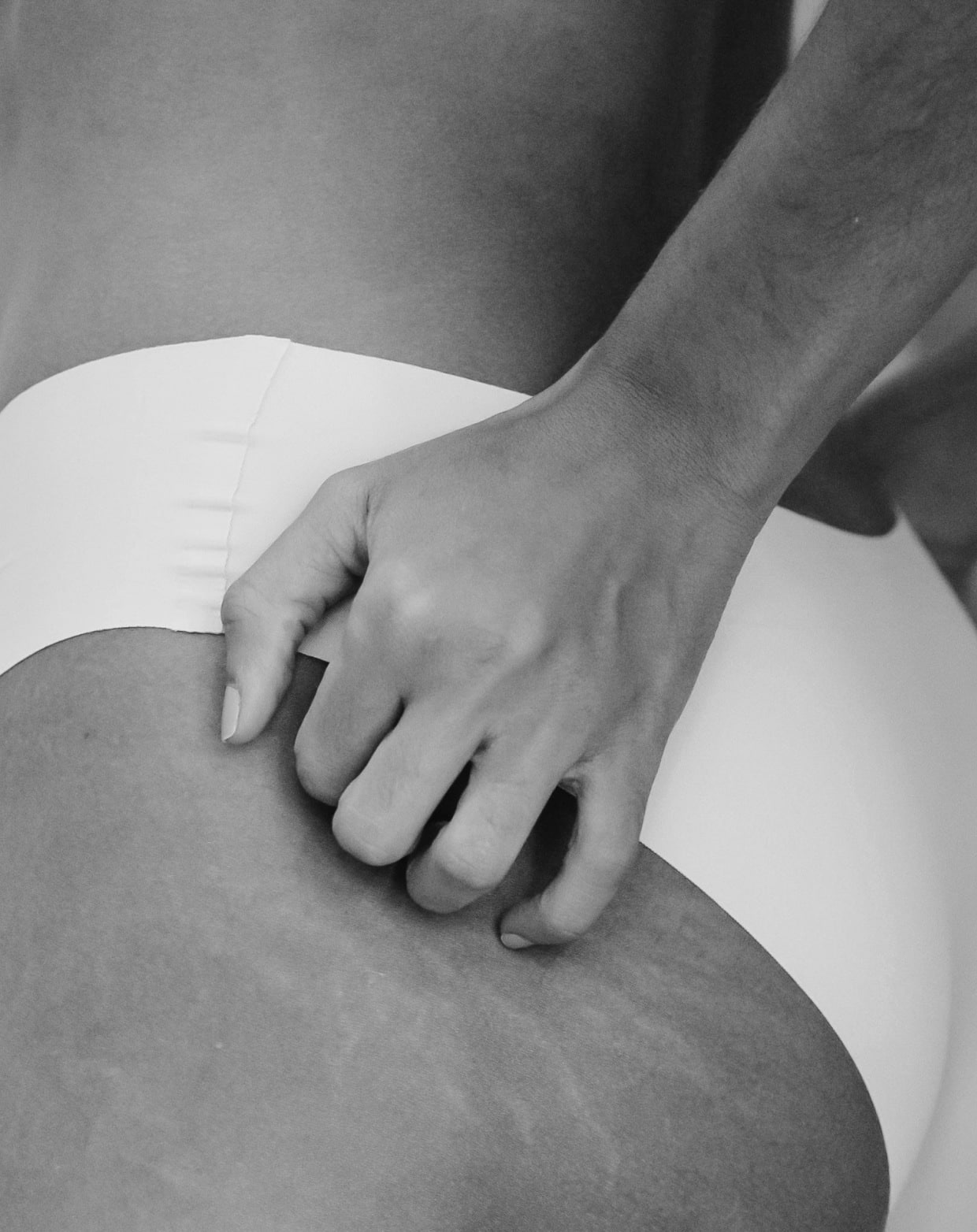
LED treatment can be used to treat all stretch marks, recent and old, red and white, of any phototype (phototypes I to VI: white to black skin). The light emitted by LEDs stimulates the production of collagen and elastin, essential for skin elasticity and tone. LED Photomodulation is a non-invasive, painless treatment that improves skin aesthetics by fading stretch marks.
After a diagnosis by Dr. Santini, a physician and plastic surgeon in Paris, the number of sessions prescribed will enable a clear improvement in your skin. A minimum of 8 to 10 sessions is required for lasting results, depending on the type of stretch marks, the quality of the skin, and the number and extent of the areas to be treated.
How can LED photo therapy be used to treat alopecia?
Alopecia is a diffuse loss of hair and, by extension, of scalp hair. LED photomodulation acts directly on alopecia and hair quality by stimulating the hair bulb. Clinical results obtained with LED treatments in cases of androgenic alopecia are highly encouraging and promising: rapid cessation of hair loss followed by hair regrowth with improved hair quality (volume, shine, elasticity and re-pigmentation) progressing with time and the number of sessions.
Androgenetic alopecia affects the majority of men, sometimes at a very early age (25), and over 20% of women, particularly after the menopause.
How does LED photoactivation affect capillary stimulation?
LED light improves the hair's biological environment by increasing blood and lymph microcirculation to the follicles. Red-light LEDs in particular stimulate hair cells and papillae, which assimilate nutrients more rapidly. As a result, hair grows stronger and thicker, offering silkier, better-quality hair.
LED is a side-effect-free alternative to all existing products. Scalp LED treatments can be used alone or in combination with scalp mesotherapy. Dr. Santini also offers three LED sessions after a session of hair transplant whether FUT (classic hair transplant) or FUE (follicular unit extraction). In the latter case, LEDs stimulate the take-up of the implanted grafts, with a synergistic action to prevent hair loss, while reducing post-operative edema of the forehead and upper face.
What are the contraindications to an LED photomodulation session?
There are no contraindications to an LED photomodulation session. All skin tones and all skin types can benefit from LED: sensitive skin, acne-prone skin, recent or old scars...
How does an LED photomodulation session work?
After thoroughly cleansing your face, Dr. Santini protects your eyes with protective eyewear. The LED will then be positioned between 8 and 20 cm from your skin, depending on the light energy emitted and the desired effect.
The session lasts from 15 to 30 minutes, with the intensity and color of the light varying according to each type of treatment. LED treatment is totally painless. All you feel is a pleasant sensation of diffuse heat.
What to do after an LED photomodulation session?
Our LED devices are guaranteed UV-free. Unlike lasers or other more invasive treatments, no special precautions are required, particularly with regard to exposure to the sun. The energy delivered causes only a slight reddening of the skin, which disappears after a few hours. As a result, you can resume your normal activities immediately after the treatment.
It's advisable to keep your skin well moisturized in the days that follow, to nourish it deeply and optimize the proper functioning of the targeted cell lines.
How much does an LED photomodulation session in the 16th arrondissement of Paris cost?
Expect to pay an average of €50 for an LED photomodulation session at the practice of Dr. Christelle Santini, a physician and plastic surgeon in 75116 Paris.
Dr Santini will provide you with an estimate for a complete treatment plan.
Highlights of LED phototherapy in Paris
- Non-invasive, completely pain-free treatment.
- No need to avoid the sun.
- Versatile action, proven for many indications.

WRITTEN AND MEDICALLY REVIEWED BY:
Dr Christelle Santini
specialist in cosmetic surgery & medicine in paris
I am Dr. Christelle Santini, a specialist in cosmetic surgery and medicine with over 16 years of experience, based in Paris. I am:
- Surgeon qualified by the Collège Français de Chirurgie Plastique et Esthétique, registered with the Conseil de l'Ordre des Médecins in Paris.
- Member of the French Society of Plastic, Reconstructive, and Aesthetic Surgery (SoFCPRE).
- Former Assistant Chief of Staff at the Paris School of Medicine.
- My RPPS ID: 10005192595
My goal is to provide each patient with personalized care that combines transparency and safety with technical expertise and natural-looking results.
Our exchanges with Internet users
Séverine
Publié le 08 juillet 2024
Bonjour Docteur Santini, j’ai entendue parler de la photomodulation LED comme une méthode potentiellement efficace pour la régénération de la peau et la réduction des cicatrices. ça m’intéresse beaucoup, car je suis confrontée à des cicatrices d’acné anciennes qui touchent ma confiance en moi depuis plusieurs années. J’ai essayé plusieurs traitements comme les crèmes dépigmentantes, mais les résultats ont toujours été décevants ou temporaires. J’aimerais savoir comment cette thérapie fonctionne exactement pour traiter les cicatrices d’acné, pouvez vous docteur m’en dire un peu plus sur ça ? Merci.
Dr Santini
Publié le 28 septembre 2024
Bonjour Madame,
Pour que je puisse vous conseiller, il est préférable d’en discuter lors d’une consultation pour voir si la photomodulation est efficace dans votre cas ou s’il est nécessaire de faire du laser spécial cicatrices d’acné.
N’hésitez pas à me contacter pour une prise de RDV au 01.45.50.18.13 ou sur Doctolib.