Scar treatment
Scars and stretch marks are aesthetically very similar, and both can alter the aesthetics of the skin on the face and body.
There are various aesthetic medicine solutions to improve the aesthetic appearance of a scar without surgery or pain: laser, injections, dermabrasion,...
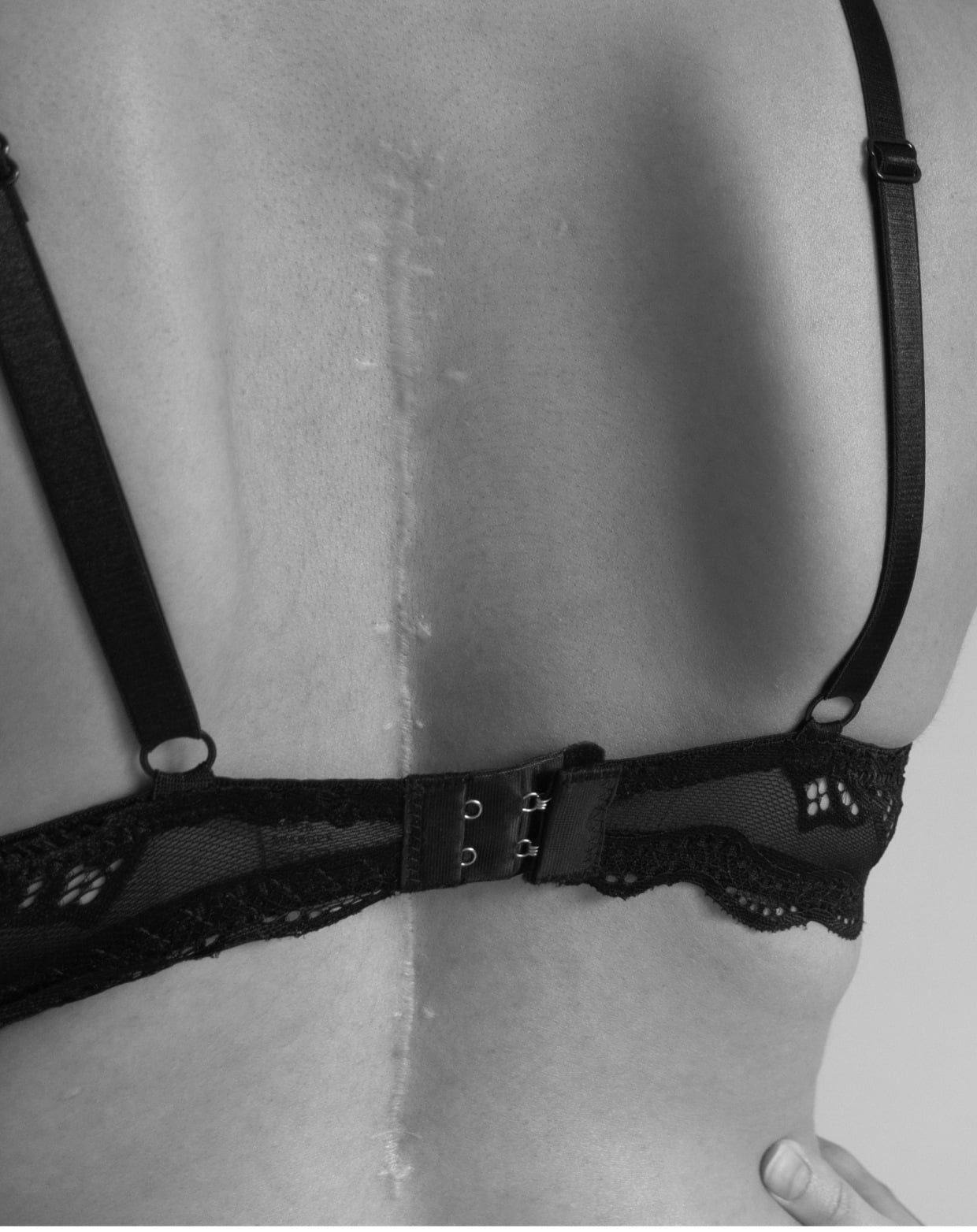
General information on scars
The skin is an organ that constantly and rapidly renews itself. The epidermis from its basal base and the dermis thanks to fibroblasts. After trauma (surgery or injury), the skin sets up healing processes to re-establish the cutaneous barrier. But this skin repair is sometimes of poor quality, resulting in scars that are more or less visible and unsightly. The choice of techniques to attenuate scars will depend on their location, age and depth, in order to restore flawless, remodeled skin if possible. The same approach applies to stretch marks, as their formation mechanism is very similar. Stretch marks are in fact dermal breaks, and will develop in the same way as scars.
The different causes of scars and stretch marks
- In the case of scars, the synthesis of coarser collagen fibers results in a fibrous trace: the risk of scarring is therefore all the greater the greater the loss to be repaired (deep or wide wound), the shorter the time required or the poor quality of the skin (more aging fibrocytes than young fibroblasts). A dysfunctional metabolism (deficiencies, chronic illnesses such as diabetes, autoimmune disease, etc.), repeated trauma or infection will also alter this repair process.
- In the case of stretch marks, excessively distended elastic fibers break down mechanically. This often happens during pregnancy or obesity, on the stomach as well as the chest, or sometimes the face.
The different types of scars
Scars can be classified according to their morphological appearance.
Flat scars
This is the most classic form. A scar, like a stretch mark, continues to shape itself over months: first it's red, then pink, before turning pearly white after 6/12 months.
Retractile scars
Traction on the scar zone produces rigid, often raised, fibrous cords. In addition to its disharmonious appearance, this type of scarring can cause functional discomfort.
Hypertrophic or keloid scars
These are proliferative, often inflammatory scars. Their protruding relief means they are easily ulcerated, increasing the risk of superinfection. They are often itchy.
Hollow atrophic scars
They correspond to depressed lesions. These hollow scars are common on acne lesions, greatly altering the sensuality of the face.
Which scars can be treated?
Aesthetic scar treatment involves working on a stabilized, non-infected scar.
In general, surgical treatment can be applied to any embarrassing or unsightly scar, provided the skin is healthy and in good condition.
This procedure is usually performed under local anaesthetic.
The medical treatment of a scar can be considered if the lesions are neither too deep nor too pronounced. Different techniques are possible, depending on the strategy chosen: eliminating the abnormal tissue or helping it to regenerate naturally.
Solutions for reducing scars
Dr Santini's non-surgical treatment of scars and stretch marks is usually based on a simple concept: induce dermal remodeling by stimulating the activity of young fibroblasts, capable of regenerating young, smooth, supple and toned skin.
Preventive solutions to reduce scarring
One of the special features of cosmetic surgery is to choose a set of solutions aimed at making a scar as imperceptible as possible, even if there is always an element of uncertainty linked to individual reactions. This is particularly important for cosmetic breast surgeryto enhance the beauty of the breasts.
To prevent the appearance of scars, Dr Santini acts on three levels
- in the choice of technique, favouring access routes with hidden scars (via the axilla or incision in the mammary fold, for example, for fitting breast implants);
- in suturing, using a fine, elastic surgical suture that leaves as few marks as possible;
- by offering a preventive Urgotouch laser treatment at the end of the operation, to stimulate the activity of young fibroblasts. This is a painless, one-off treatment performed at the end of the suture at the end of the surgical procedure.
Curative solutions for scars and stretch marks
Depending on the age, location and depth of the scar, different solutions are possible.
How to remove a scar or stretch marks without laser surgery?
Depending on the type of laser used, it is possible to perform superficial abrasion or deeper dermabrasion . An ablative laser enables epidermal resurfacing for the most superficial scars, while a laser targeting depth (ablative or non-ablative) promotes dermal remodeling. Dr. Santini's practice offers a range of solutions, including the Hollywood Spectra laser.
How can I remove a stretch mark or scar without surgery using LED phototherapy?
LED phototherapy uses cold light to act on photoactivation or photomodulation processes. Orange light, for example, reduces the redness of a recent stretch mark or fresh scar.
How do I remove a scar or stretch marks using a peel?
The peeling aims to remove a more or less deep part of the skin so that it can regenerate perfectly:
- superficial peeling targets the epidermis
- the medium peel targets the epidermis and superficial dermis;
- deep peeling targets the entire skin and can be performed on a very small area if required.
How can I fade stretch marks or scars with the Morpheus 8 treatment?
The treatment Morpheus 8 treatment combines the principle of bipolar radiofrequency with the microneedling technique to heat the dermis up to 7 mm deep. This hyperthermia activates stem cells, resulting in scar remodeling over about 3 weeks.
Scar treatment results
It takes 3 to 4 weeks to see skin remodeling and regeneration. Several sessions may be necessary to smooth the scar and restore rejuvenated tissue. All recent scars must be well protected from the sun, to avoid hyperpigmentation. Aesthetic medicine techniques can achieve results after several sessions.
The price of fading scars
The cost depends on both the technique chosen and the duration of the protocol.
During the initial consultation, Dr Santini systematically draws up an estimate showing the cost of reducing scars or stretch marks without surgery.
WRITTEN AND MEDICALLY REVIEWED BY:
Dr Christelle Santini
specialist in cosmetic surgery & medicine in paris
I am Dr. Christelle Santini, a specialist in cosmetic surgery and medicine with over 16 years of experience, based in Paris. I am:
- Surgeon qualified by the Collège Français de Chirurgie Plastique et Esthétique, registered with the Conseil de l'Ordre des Médecins in Paris.
- Member of the French Society of Plastic, Reconstructive, and Aesthetic Surgery (SoFCPRE).
- Former Assistant Chief of Staff at the Paris School of Medicine.
- My RPPS ID: 10005192595
My goal is to provide each patient with personalized care that combines transparency and safety with technical expertise and natural-looking results.
Our exchanges with Internet users
Soini
Publié le 08 novembre 2025
J’ai des cicatrices au niveau du visage que je souhaite enlever, des cicatrices ethniques ( Culture Peulh/Fulani). Est il possible de faire recours à la chirurgie pour les enlever ?
Dr Santini
Publié le 26 novembre 2025
Bonjour,
Les cicatrices ethniques de type Peulh/Fulani sont souvent anciennes et profondément ancrées dans la peau, ce qui nécessite une évaluation très précise avant de déterminer les options possibles.
Il existe plusieurs techniques — chirurgicales ou non — qui peuvent permettre d’atténuer ou d’améliorer l’aspect des cicatrices, mais l’indication dépend de nombreux facteurs :
✔️ profondeur et largeur des cicatrices,
✔️ qualité de la peau,
✔️ tension naturelle des tissus,
✔️ risques de cicatrisation selon votre phototype.
Dans certains cas, une approche combinée peut être envisagée (chirurgie, lasers, procédures de resurfacing), mais cela doit être défini au cas par cas après un examen clinique.
Je vous recommande de venir en consultation afin que je puisse examiner la zone et vous orienter vers la solution la plus adaptée, en toute sécurité, selon votre peau et vos objectifs.
Bakhta
Publié le 20 octobre 2025
L’apparence de ma cicatrice est très prononcée sur mon cou à cause d’une opération chirurgicale de la thyroïde que j’ai subie il y a un an. Je souhaite maintenant la faire enlever et j’aimerais savoir si un traitement chirurgical est la meilleure solution dans ce cas? Cordialement
Dr Santini
Publié le 30 octobre 2025
Bonjour,
Les cicatrices post-chirurgicales au niveau du cou peuvent en effet être améliorées, soit par un traitement chirurgical, soit par des techniques non invasives selon leur aspect (injections, laser, peelings ou traitements combinés).
Une évaluation en consultation permettra de déterminer la meilleure approche selon la texture, la couleur et l’épaisseur de votre cicatrice. L’objectif est d’obtenir un résultat plus discret et harmonieux
Je vous invite à prendre rendez-vous pour un avis personnalisé, en présentiel ou en visioconsultation si vous n’êtes pas à Paris.
Bien à vous.
Lilou
Publié le 05 juin 2024
Bonjour, j’ai des cicatrices sur mes bras qui me causent des démangeaisons et un inconfort, et elles limitent le choix des vêtements que je peux porter, surtout ceux qui ont des manches courtes. Je souhaite suivre un traitement pour mes cicatrices, mais d’abord, je voudrais savoir si le traitement serait approprié même si les cicatrices sont apparues il y a environ 3 ans? Merci pour votre réponse
Juandg185
Publié le 02 juin 2022
Bonsoir. Je voulais savoir le prix de la dermabrasion merci
Dr Santini
Publié le 03 juin 2022
Bonjour,
je ne pratique actuellement plus la dermabrasion, mais je peux vous proposer d’autres alternatives.
Nous pourrions en discuter lors d’une consultation si vous le souhaitez. N’hésitez pas à contacter pour secrétariat au 01.45.50.18.13.
Bien à vous