Calf lipofilling
Calf lipofilling can be used to increase the curvature of calves considered too thin, often referred to as "rooster calves". Legs that are too thin can detract from the beauty of a silhouette, breaking its harmony and balance. Leg lipostructure will simulate the contour created by the internal and/or external twin muscles, by injecting fat taken from elsewhere on the patient. Calf lipofilling is the technique of choice when there is sufficient fat to be recovered from the patient to fill the calves, as an alternative to calf implants.

What are the indications for calf augmentation by lipofilling?
Beautiful legs enhance a figure and make you want to go bare-legged, without embarrassment or complexes.
If big calves are not sensual, then the opposite is also true, with rooster calves. While it's sometimes possible to tone your calves through sport, the results can sometimes be disappointing. This is all the more true if you build up your thighs at the same time, as the volume ratio of the member will not change.
As an alternative to calf implantsDr Christelle Santini offers this more natural leg lipostructure solution, with no foreign bodies and no risk of rejection.
This requires sufficient fat to be removed by liposuction, such as a tummy tuck or liposuction of the thighs and saddlebags.
What to do before the calf lipofilling procedure?
A plastic surgery consultation at least 15 days apart is mandatory before the operation, during which medical photographs are always taken.
Dr. Santini will verify the indications for lipofilling leg reshaping, based on your expectations and needs. Particular attention is paid to the donor area, where liposuction will be performed, to offer a 2-in-1 effect.
This is where a dual medical and artistic approach enhances the result.
Dr Santini will also prescribe a compulsory consultation with the anaesthetist and give you his main recommendations:
- Smoking cessation 1 month before surgery, to improve fat cell uptake, thanks to better neo-vascularization.
- Stop taking aspirin, anti-inflammatory drugs or oral anticoagulants for 15 days prior to calf surgery, to reduce the risk of bleeding.
- Stop taking oral contraceptives 1 month before surgery, to reduce thrombo-embolic risk.
- Fasting for at least 6 hours on the day of surgery.
By law, you must wait at least 15 days before undergoing cosmetic surgery.
How does calf lipofilling work?
A one-day hospital stay is required for a procedure lasting an average of 2 hours 30 minutes under general anaesthetic.
The procedure is carried out in two stages.
The first part involves liposuction on predefined areas with excess fat.
This is a classic procedure, performed with a cannula after Dr Santini has made micro-incisions.
The harvested fat is methodically filtered to purify it and rid it of the blood and oil formed by cellular debris. The aim is to retain the most vital fat cells, so as to obtain a high-quality graft.
The second stage consists of reinjecting this fat using an autologous graft.
This lipostructure is performed by syringe, on demand and in sufficient quantity.
Dr. Santini works to reshape the calf in all its dimensions (deep, superficial and lateral), to enhance its contours with a natural look. Over-correction must be sought to prevent fat loss from the graft: melting or fat loss from the graft is in fact normal and expected in a maximum ratio of 30%, corresponding to fat cells that will not take.
The procedure ends with the application of a compression bandage to the calves and to the area slimmed by liposuction.
What to do after calf lipostructure surgery?
The patient is discharged on an outpatient basis during the day, with a prescription for painkillers. Pain on the calf is almost non-existent, and sometimes a little more marked in the liposuction area.
The panty (compression garment to reduce edema and tissue detachment) is worn 24 hours a day for 3 to 4 weeks.
Injectable anticoagulants are often added.
The patient must rest for a minimum of 3 days, and must not worry about minor walking difficulties for a week.
Sports activities are not recommended for a month. A check-up is scheduled after two weeks at the latest.
A consultation (possibly at a distance) is scheduled at 3 months to assess the stabilization of the aesthetic result.
Results should never be judged immediately after calf lipostructure, as volumes are increased by edema and around ¼ of the fat cells will resorb.
Incisions are small, hidden at best, and no larger than 3 mm.
Sutures are absorbable. Scars fade after two months.
Highlights of calf lipofilling
- Natural, foreign-body-free results.
- No visible scars.
- 2-in-1 effect with liposuction, but requires sufficient fat reserves.
Calf lipofilling in a nutshell...
What to do before calf lipofilling?
- 1 to 2 plastic surgery consultations with a quote and photographs.
- A 15-day cooling-off period is mandatory.
- Consultation with anaesthetist, blood test.
- Stop smoking at least 1 month before, stop taking aspirin or anti-inflammatory drugs 10 days before calf lipofilling.
How is calf lipostructure performed?
- Leg lipofilling is performed under general anaesthetic
- Liposuction of donor areas and purification of fat to be reinjected
- 1.5 to 2.5 hours of surgery for calf lipofilling
- Most patients return home the same day.
What is the post-operative course of lipofilling calf augmentation?
- Absorbable or absent threads.
- Compression garment must be worn.
- Follow-up consultation with your plastic surgeon 7 to 10 days after lipofilling.
- Stop sport for 4 to 6 weeks.
- Allow 7 to 10 days off.
- Final result of calf lipofilling after 3 to 6 months.

WRITTEN AND MEDICALLY REVIEWED BY:
Dr Christelle Santini
specialist in cosmetic surgery & medicine in paris
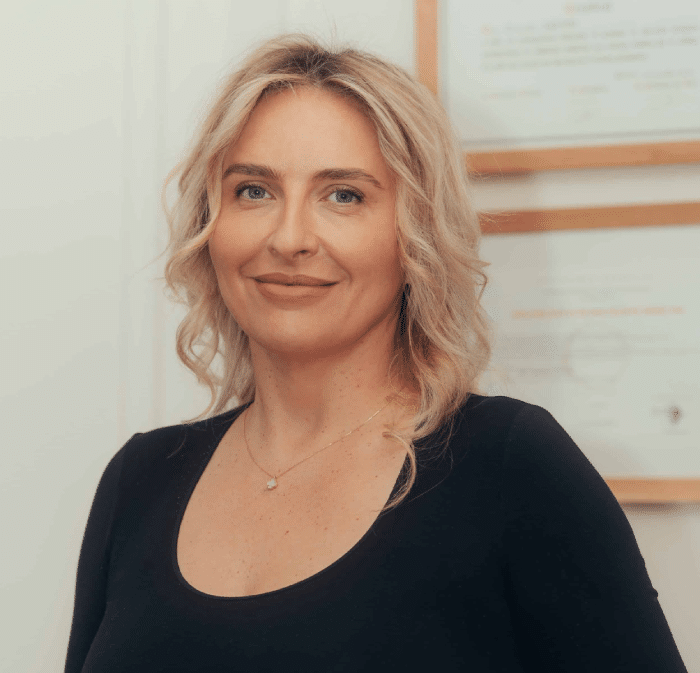
I am Dr. Christelle Santini, a specialist in cosmetic surgery and medicine with over 16 years of experience, based in Paris. I am:
- Surgeon qualified by the Collège Français de Chirurgie Plastique et Esthétique, registered with the Conseil de l'Ordre des Médecins in Paris.
- Member of the French Society of Plastic, Reconstructive, and Aesthetic Surgery (SoFCPRE).
- Former Assistant Chief of Staff at the Paris School of Medicine.
- My RPPS ID: 10005192595
My goal is to provide each patient with personalized care that combines transparency and safety with technical expertise and natural-looking results.
Our exchanges with Internet users
Amira
Publié le 30 janvier 2026
Bonjour Madame, en espérant que vous allez bien. J’ai eu recours à un lipofilling des mollets il y’a deux ans. Mes mollets sont mieux qu’avant mais j’aimerais de nouveau ajouter un peu graisse une niveau du haut et surtout du bas du mollet. Est-ce possible ? Je suis très fine mais j’ai de la graisse au niveau du haut du ventre et du bas.
Dr Santini
Publié le 04 février 2026
Bonjour,
Merci pour votre message. Un complément de lipofilling au niveau des mollets peut parfois être envisagé, à condition que l’examen clinique confirme la faisabilité, la qualité des tissus et la présence de zones donneuses suffisantes. Même chez les patientes très fines, certaines zones peuvent effectivement permettre un prélèvement, mais cela doit être évalué précisément en consultation.
L’analyse de la morphologie globale et de vos attentes est essentielle afin de garantir un résultat harmonieux et sécurisé. Je vous invite donc à prendre rendez-vous au cabinet pour en discuter et réaliser un bilan personnalisé.
Bien cordialement,
Dr Christelle Santini
Breant
Publié le 11 juin 2025
Bonjour Madame, J ai une atrophie d un mollet et je n ai jamais portée de robe au dessus du genou car je suis complexée et moquerie des filles quand j allais en cours. De toute ma vie j ai vécu en pantalon ou robe longue. Même si j ai 65 ans je souhaiterai enfin grâce au progrès de la chirurgie améliorer cette imperfection de naissance. Pouvez vous me renseigner si ce sera possible. Merci d avoir pris connaissance de mon message.
Dr Santini
Publié le 18 juin 2025
Bonjour,
L’atrophie d’un mollet peut aujourd’hui être corrigée par des techniques de chirurgie réparatrice ou esthétique, comme la pose de prothèse de mollet ou, dans certains cas, un lipofilling (injection de graisse autologue), selon votre morphologie et le degré d’asymétrie.
Une consultation permettra d’évaluer précisément votre cas et de déterminer la solution la plus adaptée à vos attentes. N’hésitez pas à contacter mon secretariat pour une prise de rendez-vous au 01 45 50 18 13.
Bien à vous,
Dr Christelle Santini
CHRISTIANE
Publié le 13 mars 2025
Bonjour je souhaite faire une lipostructure de mes jambes pour avoir un beau galbe des jambes car je pense avoir des mollets convenables mais j’ai des chevilles trop fines d’où un déficit de structure du galbe de la jambe donc je souhaite augmenter mes chevilles pour avoir un beau galbe Merci de votre retour
Dr Santini
Publié le 18 mars 2025
Bonjour,
La lipostructure des jambes est une solution efficace pour améliorer le galbe et redonner de la forme aux zones ciblées, comme les chevilles. En injectant de la graisse proprement prélevée sur une autre zone de votre corps, il est possible d’ajouter du volume de manière naturelle et durable, créant ainsi un meilleur équilibre et un galbe harmonieux.
Lors de la consultation, nous pourrons discuter de vos objectifs et des possibilités spécifiques pour vos chevilles, afin de déterminer si la lipostructure est la solution la plus adaptée à votre demande.
N’hésitez pas à prendre rendez-vous par téléphone au 01 45 50 18 13 ou sur Doctolib : Christelle Santini
Bien à vous.
Victoria
Publié le 12 décembre 2022
Bonjour
Je vis en France , le problème avec mes mollets c’est qu’ils sont fin et je n’ai pas assez de graisse pour faire le lipofiling est ce qu’il a pas d’autre solution pour m’aider à les augmenter ?
Merci
Dr Santini
Publié le 28 décembre 2022
Bonjour Madame,
Le mieux est de venir me voir en consultation, nous pourrons ensemble trouver la meilleure solution pour vos mollets.
N’hésitez pas à contacter mon secrétariat : 01.45.50.18.13.
Bien à vous
Eva
Publié le 22 mai 2021
Bonjour,
J’habite dans l’île de France (Essonne)
J’ai un problème de mollet qui es beaucoup plus grosse que l’autre.
J’aimerai savoir comment ça se passe avec vous. Car je n’en peu plus de cet problème.
Bien cordialement.
Dr Santini
Publié le 25 mai 2021
Madame bonjour,
Il serait bien de prendre rendez-vous en consultation. Afin de déterminer si cette asymétrie est lié à un muscle trop développé ou une graisse localisé.
Nous restons à votre entière disposition aux 01 45 50 18 13. Cordialement,